If you’ve ever gone to an ER, urgent care, imaging center, lab, or doctor’s office, you’ve probably been handed a clipboard (or iPad) and asked to sign something like:
- Consent for treatment
- Financial responsibility agreement
- Authorization to bill insurance / assignment of benefits
The wording usually sounds reasonable:
“I agree to be responsible for charges not paid by my insurance.”
Most people sign—because if you get care, you should pay what you legitimately owe.
Here’s the part patients rarely get told: your signature can make you the backstop for a pricing and contracting system you don’t control. You sign once, often in a stressful moment and without seeing real prices. Meanwhile, hospitals and insurers set the rules and rates through contracts you never see.
A real-world story: when insurance costs more than paying cash
One of our clients had health insurance and went to the ER. After the visit, we compared outcomes and discovered something that feels impossible until you see it on paper:
- The patient’s out-of-pocket responsibility using insurance was higher than the hospital’s cash price.
- In fact, her out-of-pocket amount was 152% of the cash price.
At that point, a reasonable person asks:
“Why can’t I just pay the cash price?”
Here’s the catch: many hospitals will refuse and say some version of:
“If you have insurance, we are contractually required to bill your insurance.”
So even when a patient wants to opt out and pay a straightforward price, the system can force them back into the insurance pathway—where the patient may end up owing more.
What patients think they signed (and the big picture they don’t see)
When patients sign the form, most people assume (often without even realizing it) that the price they’ll be asked to pay is reasonable—and that it makes sense to be responsible for whatever insurance doesn’t cover.
But the big picture is this: healthcare pricing is messy on purpose. Sticker prices are often inflated, and insurance rules can push costs back onto the patient. The form itself isn’t the problem—the problem is being asked to accept open-ended responsibility without transparent prices and without control over the rules that determine the final bill. When insurer–hospital negotiated prices are not reasonable (from the patient’s perspective), the patient is still the one legally required to hold the bag.
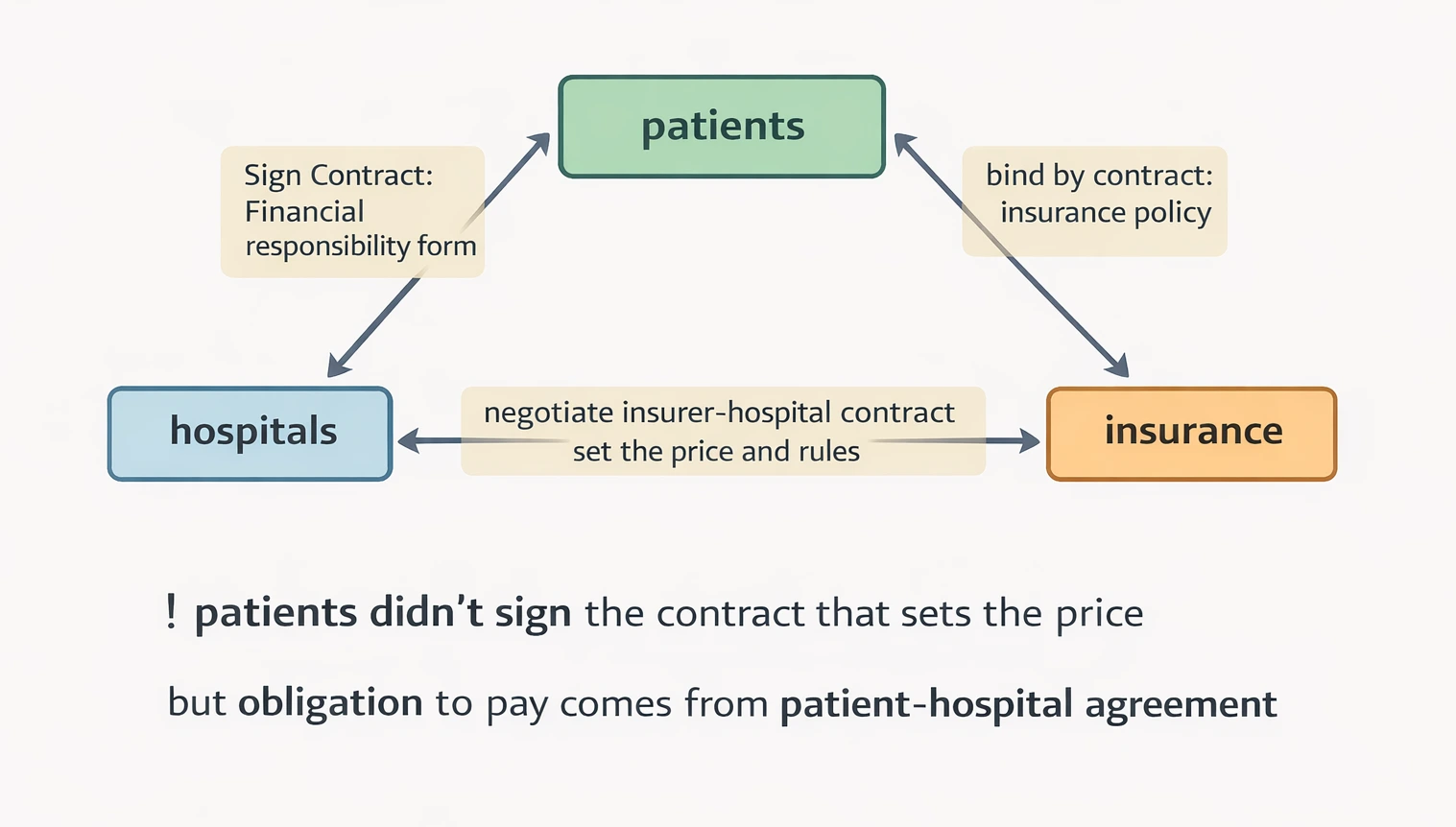
In many of the predatory billing situations we see, the insurer–hospital contract ends up benefiting both the insurer and the hospital—without insurance truly representing the patients' interests.
If you already signed, don’t panic
Signing a financial responsibility form does not mean:
- every line item is correct,
- the coding is accurate,
- the claim was processed properly,
- the amount you were billed is the only lawful/appropriate outcome,
- or you must pay immediately without questions.
Think of your signature as the hospital’s permission to start the billing process—not proof the final bill is accurate.
What you can do about the Financial Responsibility form
Before care: Add a cap to the pricing
In Never Pay the First Bill, author Marshall Allen suggests writing a clause like:
“I consent to appropriate treatment and (including applicable insurance payments) to be responsible for reasonable charges up to two times the Medicare rate.”
Then:
- Take a photo for your records.
- If you later need to find it in a sea of photos, search your phone for “Medicare rate.”
If you’re handed an iPad and can’t add the clause, ask for the paper version. You can cross out broad language like “I agree to be responsible for charges not paid by my insurance,” add the cap clause above, and take a photo.
After care: request a copy and revoke the signed form
If you realize you signed this form without editing it (or you’re not even sure what you signed), request a copy of the signed Financial Responsibility form through the hospital’s medical records page or patient portal.
Once you have it, tell the hospital—in writing—that you revoke the agreement and want it noted on your account. The next time you receive care, they’ll need to present a new form for you to sign.
Keep copies of your request and the hospital’s response for your records.
If you’re dealing with a bill that doesn’t make sense, start by getting a copy of what you signed and comparing your bill to your insurance EOB. Confusing paperwork is exactly how patients get stuck holding the bag—and it’s also where you can begin to push back.